
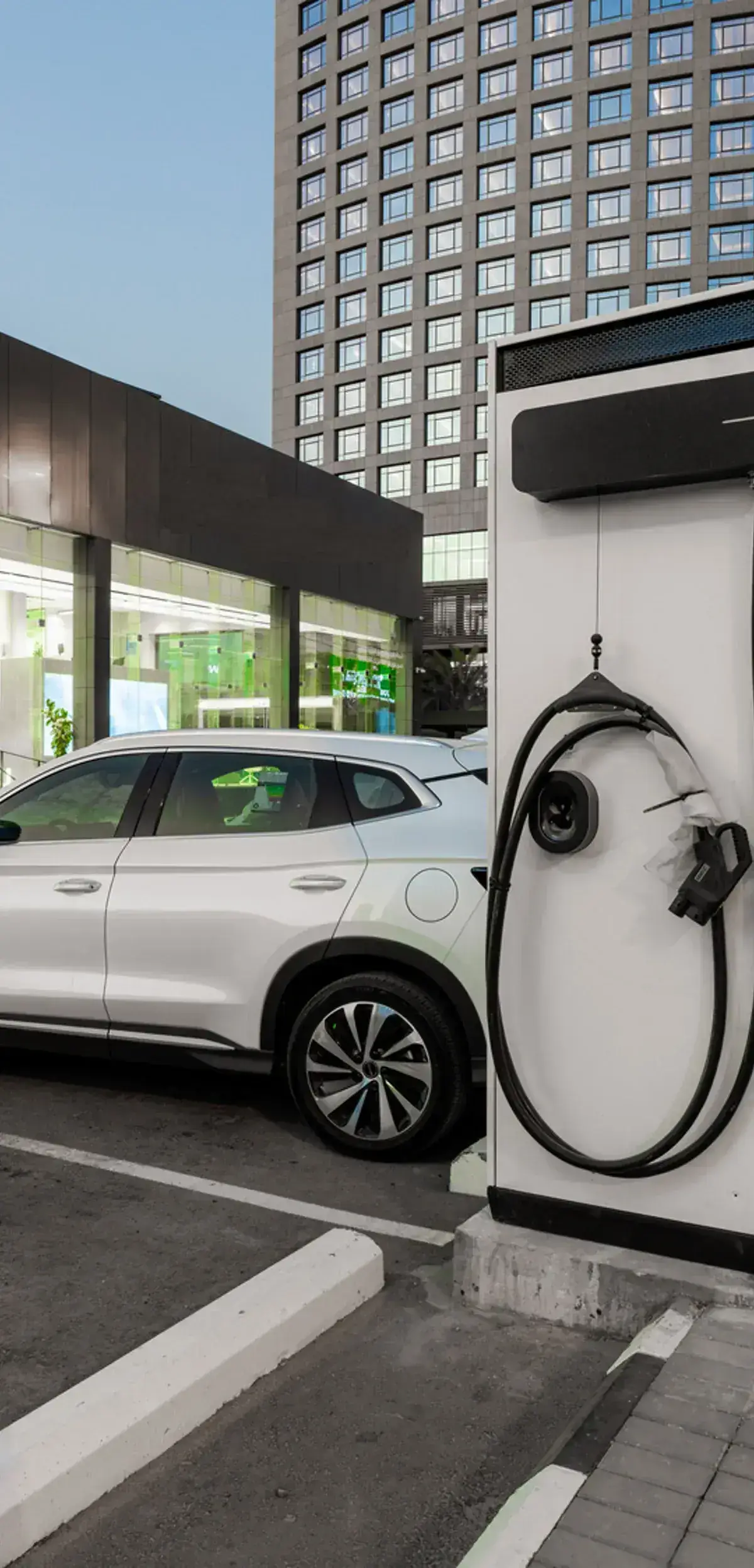
EV charging for workplaces and commercial buildings
We prepare the building's electrical system, supply and install the chargers, and run them through our CPMS for offices, commercial buildings and fleet depots across Saudi Arabia.
What you gain
Why offer EV charging at work
Cars stay in a workplace car park for hours every day. That is enough time to charge on an AC charger, without the need for fast charging.
Convenience for staff and visitors
Employees charge while they work, so they do not need a home charger or a trip to a public station.
Higher property value
Charging bays help offices, malls and compounds attract tenants and visitors who drive EVs.
A fleet ready for every shift
Company vehicles start every shift charged, and the same infrastructure can grow with the fleet.
Control and billing
With our CPMS you decide who can charge, when and at what tariff, and you see the usage of every charger.
Project planning
Electrical requirements for commercial buildings
Most of the work in a commercial project is checking and preparing the building's electrical system. During the survey we check:
Available capacity
Spare capacity in the main supply, transformer and main distribution board after the building's peak load, which is often air conditioning in summer.
Circuits and protection
A dedicated circuit for each charger, with the correct breaker, residual current protection and earthing.
Cable sizing and routes
Cables sized for the charger's current, the distance to the parking bays and summer heat, run in conduit or cable trays.
Civil works
Trenching, conduits, concrete bases, protective bollards and shade for chargers in open parking.
Saudi Electricity Company approvals
SEC approval is needed when the site requires a new connection or a higher load. Our team handles the application for you.
Certified chargers and connectivity
SASO-certified chargers and a network connection so each charger can reach the CPMS over OCPP.
Our method
When the building's supply is not enough
Many AC chargers or high-power DC chargers can exceed what the building can supply. We compare these options during the survey and recommend the lowest-cost one that meets your charging needs:
Load management
Chargers share the available capacity and slow down when the building load is high, so more chargers fit on the same supply.
Phased rollout
Lay conduits and cable routes for the final number of bays now, then add chargers as demand grows without digging again.
Supply upgrade
A larger connection or a new transformer from SEC when the site needs many fast chargers running at full power.
Battery-buffered chargers
A DC charger with a built-in battery draws power slowly from the building and delivers high power to the car. It can avoid a supply upgrade at sites with only a few fast-charging sessions a day.
Project scope
Cost-effective charging for large fleets
The cost of a fleet depot depends mostly on its peak demand. Sizing the supply for the energy the fleet needs each night, rather than for every charger at full power at once, keeps the connection smaller.
Overnight AC charging
7 to 22 kW AC chargers for vehicles parked overnight or for a full shift. They cost the least per bay.
DC fast charging between shifts
30 to 400 kW DC chargers for vehicles that return between shifts, with higher-power options for trucks and buses.
Smart charging and reports
Chargers spread sessions across the night within the site's capacity, and the CPMS reports the energy used by each charger.
Maintenance and fast response
Maintenance contracts with a 48-hour on-site response in major cities, or 4 or 24 hours for depots that cannot afford downtime.
Our process
How a commercial project runs
Free site survey
We review the electrical system, the parking layout and how the chargers will be used. The survey is free.
Design and quotation
You receive a written quotation within 3 to 5 business days of the survey.
Approvals and installation
We handle SEC approvals, civil works and installation. Commercial projects take 1 to 4 weeks depending on their size.
Commissioning and warranty
We test the chargers, connect them to the CPMS and hand over. We warrant civil and installation works for 2 years, and chargers carry the manufacturer's warranty.
Quick answers
Questions about commercial EV charging.
Can't find your answer? Our team replies on WhatsApp.
WhatsAppWhat electrical upgrades does a commercial building need for EV chargers?
It depends on the building's spare capacity at peak load. For AC chargers, many buildings need only new circuits, a distribution board and cabling. Several DC fast chargers often need a larger supply from SEC, load management or battery-buffered chargers. The site survey confirms which one fits.
How many chargers can our building support?
It depends on the spare capacity at peak load. With load management, the same supply can serve more chargers because they share the available capacity.
Do we need approval from the Saudi Electricity Company?
Yes, when the project needs a new connection or a higher load. Our team prepares the application and follows it up with SEC for you.
How much does commercial EV charging cost?
DC fast chargers for commercial projects start at SAR 45,000. The total depends on the number and type of chargers, the civil works and whether the supply needs an upgrade. The survey is free and the quotation arrives within 3 to 5 business days.
Can employees or visitors pay for charging?
Yes. Our CPMS manages access and billing, and it works with chargers that support OCPP 1.6J and 2.0.1.
What warranty do commercial projects get?
We warrant civil and installation works for 2 years. Chargers carry the manufacturer's warranty of 2 or 3 years depending on the brand, with extended warranty options.
Ready to install your EV charger?
Tell us about your site for a free consultation and a project quote.
Or call us directly: +966 55 111 2998