Say you are driving from Riyadh to Jeddah, the battery is at 20%, and you need to charge fast. A DC fast charging station can take your car from 20% to 80% in 20 to 40 minutes instead of the hours standard charging takes, and then you carry on.
This article covers DC fast charging in Saudi Arabia: how it differs from standard charging, where the stations are, what charging actually costs, and how to protect your car's battery.
What is DC fast charging and how does it differ from standard charging?
Every EV has an on-board charger that converts AC power from the grid into the DC power that charges the battery. Its capacity is limited, typically 7 to 22 kW, which is why standard AC charging takes a long time.
DC fast charging works differently. The station has its own large converter, so it bypasses the on-board charger and feeds DC power straight into the battery, starting at 50 kW and reaching 350 kW in the latest generation.
Instead of waiting 8 to 12 hours for a full charge on a home charger, you can charge 80% of the battery in 20 to 45 minutes, depending on the station's capacity and your car's battery size.
Where to find fast charging stations in Saudi Arabia
Saudi Arabia's EV charging infrastructure has grown a lot in recent years. DC fast charging stations belong to several major networks that cover the large cities and intercity highways.
EVIQ, the Kingdom's largest charging network
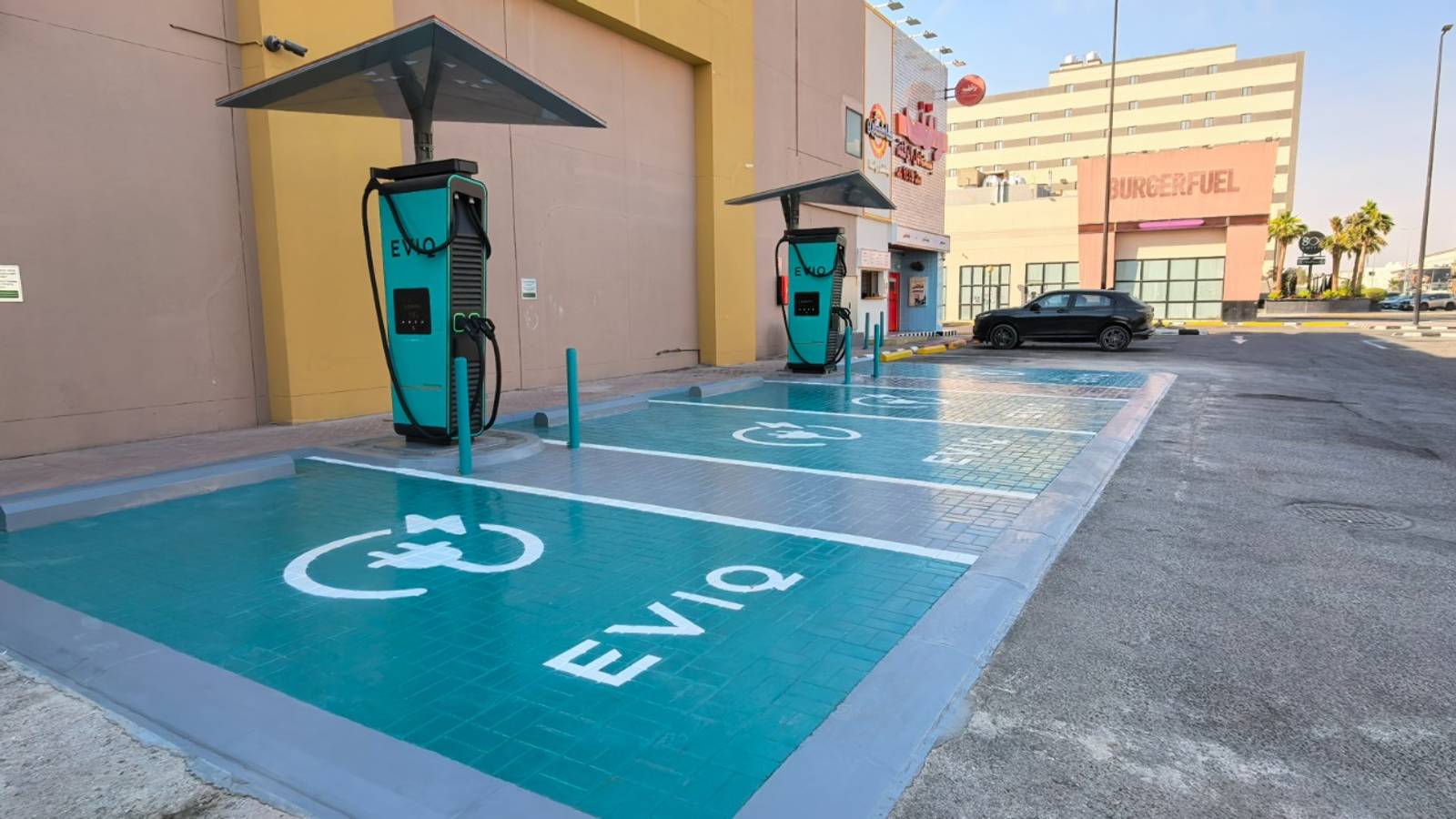
The EVIQ network, operated by the Saudi Electricity Company, is the largest EV charging network in Saudi Arabia. Its stations are in Riyadh, Jeddah, Dammam, Makkah and Madinah, and along major intercity highways. EVIQ offers fast chargers from 60 to 180 kW and supports the CCS2 standard used by most EVs sold in Saudi Arabia.
The EVIQ app shows all station locations with live availability, and you can start and pay for a charging session in it.
Electromin stations
Electromin was one of the first companies to enter Saudi Arabia's EV charging market. Its stations are mainly in Riyadh, Jeddah and the Eastern Province, with fast chargers up to 150 kW. The company also offers maintenance services and sells home chargers.
Shell Recharge stations
Shell has launched Shell Recharge at several of its fuel stations in major cities. You can charge your EV at the same station you have used for years and spend the charging time in the cafe or shop. Shell's fast chargers range from 50 to 150 kW.
Stations at malls and hotels
Many large shopping centers and hotels in Saudi Arabia have started installing DC fast chargers for visitors. You can find them at malls such as Riyadh Park, Mall of Jeddah and Al Nakheel Mall. Many five-star hotels now offer fast charging to their guests. At these stations you can shop or eat while your car charges.
Highway coverage between cities keeps improving. The Riyadh-Jeddah and Riyadh-Dammam highways now have fast charging stations at reasonable intervals, but longer routes like Riyadh-Abha still need more stations.
Per-minute pricing
Some operators charge by the minute instead of per kWh. This can cost more if your car charges slowly, and less if your car supports high-power charging, because you get more energy in less time.
Monthly subscriptions
Some networks sell monthly subscriptions that give you a lower per-kWh rate or a set number of free charging sessions. If you fast-charge regularly, a subscription can save you a fair amount.
A worked cost example
A practical example: an EV with a 60 kWh battery that you want to charge from 20% to 80%. Here is the calculation:
- Energy required: 60% of 60 kWh = 36 kWh
Planning long intercity trips? EVS's EV road-trip charging guide for Saudi Arabia maps the DC fast-charger network along the main highways. It helps owners who are comparing public and home charging before a trip.
Tips for using DC fast charging
These tips help you use DC fast charging without wearing out the battery:
Do not fast-charge above 80%: Once the battery reaches 80%, the battery management system cuts the charging speed sharply to protect it, so the last 20% can take longer than the first 60%. Repeated fast charging above 80% also stresses the cells and shortens battery life.
Plan your trip in advance and know station locations: Before any long trip, find the fast charging stations on your route and confirm they are working. Don't wait until the battery drops below 10%. That leaves you fewer options and causes needless stress.
Verify the connector type before heading to a station: The most common standard in Saudi Arabia is CCS2, the Combined Charging System. Most modern EVs support it, including BMW, Hyundai, Kia, BYD, Mercedes and recent Tesla models. Check that your car supports the connector the station offers.
Use station-finding apps: Apps such as EVIQ, PlugShare and Google Maps show the nearest fast charging station and whether it is free or in use before you head there. Some also show prices and user ratings.
Reserve fast charging for road trips only: Daily fast charging wears the battery faster than slow charging. Use home or workplace charging every day, and save DC fast charging for trips and emergencies. Most manufacturers recommend that fast charging stay at or below 20% of all charging sessions.
One more tip: charge when the battery is warm rather than very cold. On cold winter days, fast charging can be slower than usual, though in Saudi Arabia's climate this rarely matters.
The future of fast charging in Saudi Arabia
Vision 2030 plans point to these changes in fast charging:
Large infrastructure expansion: Saudi Arabia targets over 10,000 fast and slow charging points across all regions by 2030, covering cities, towns and intercity highways.
Ultra-fast charging: Chargers rated 350 kW and higher are expected in Saudi Arabia. They can charge a car from 10% to 80% in under 15 minutes, close to the time it takes to fill up with gasoline. The Porsche Taycan, Hyundai IONIQ 5 and Kia EV6 already support these speeds.
Charging stations on all highways: The plans include fast charging stations every 50 to 100 km along major intercity highways, so you can drive your EV between any two cities in the Kingdom.
Solar energy and sustainable charging: Large renewable energy projects such as NEOM and Sakaka will bring charging stations powered entirely by solar energy.
Fast charging stations can also earn money for site owners as the number of EVs in Saudi Arabia grows each year.
Want to install a DC fast charging station at your location?
Whether you run a gas station, mall, company or hotel, we provide turnkey fast charging solutions: procurement, installation, commissioning and CPMS charge point management.